

Why is narrative the new moat in B2B sales?
Narrative is the new moat because the one advantage a competitor can’t copy is the story your buyer retells — not your product. In B2B sales, a single aligned value narrative that your team and your buyer’s internal champion can both repeat consistently is harder to replicate than any feature. When ten leaders give ten different answers, deals stall; when everyone tells one story that positions the buyer as the hero, alignment rises and win rates climb.
“Your competitor can copy your features. What they can’t copy is the story your buyer repeats when you’re not in the room.”
–– Bruce Scheer
Narrative is the new moat: why the story your buyer retells, not your product, is the one advantage a competitor can’t copy.
Narrative is the new moat: in B2B sales, a single aligned value narrative — the story your team and your buyer’s champion can both retell — is harder for competitors to copy than any product feature.
A few years back, I was working with a company that Adobe was about to acquire, and I coined the quote: “I talked to 10 different leaders, and I got 10 different answers.” Thank goodness we got together with those 10 leaders and hammered out what would be a good answer that took them into the Adobe acquisition.
Meanwhile, we’re all obsessed with product differentiation. More features, faster releases, better specs. In a world where AI can help any competitor copy your capabilities in a quarter, that game keeps getting harder to win. So here’s the provocation: your buyers don’t remember your features. They remember your story. The most defensible asset in your go-to-market strategy may not be your product at all.
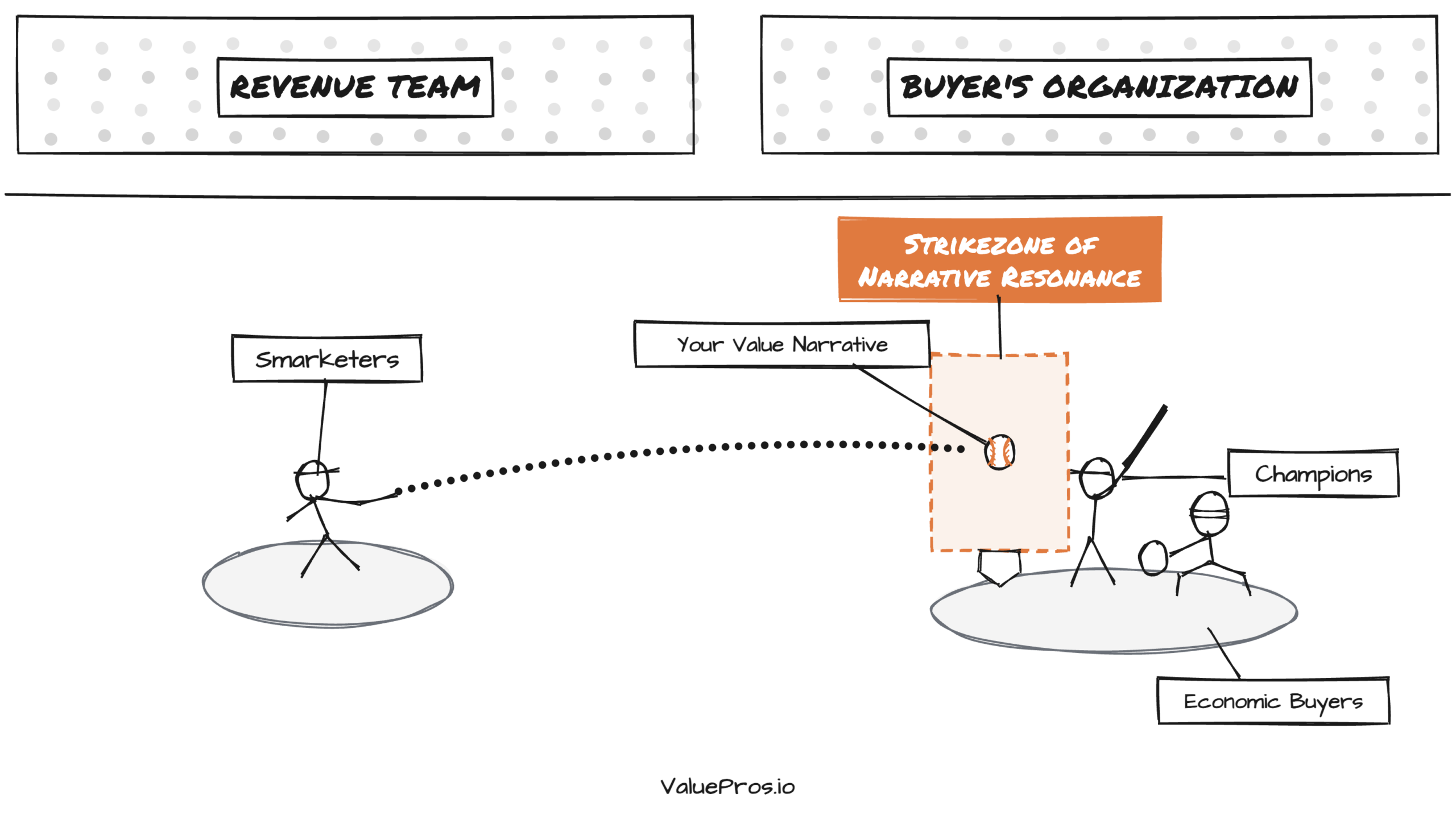
Narrative is the new moat. It’s the pitch in that picture, and everything that follows is about learning to throw it inside the zone.
The Big Problem: Random Acts
Here’s what I see inside most B2B revenue organizations.
Sellers engaging in random acts of conversation, each rep telling their own version of the company story with their own spin and their own invented narrative. Marketers producing random acts of content, campaigns, and assets that don’t ladder up to any unifying story. Everyone doing their best, and everyone doing it differently.
Random acts produce exactly what you’d expect: random results.
On the field, it’s nine pitchers on one mound, each throwing a different pitch to a different corner. No batter can time that, and no umpire can call it. The numbers bear it out: 86% of B2B purchases stall somewhere in the buying process (Forrester), and 40 to 60% of qualified pipeline ends not in a loss but in “no decision” (The JOLT Effect). The buyer moves through your sales cycle, hears nothing that resonates, and leaves uninspired. You don’t get the business, and you can’t even say why.
The Risks: What Random Acts Cost You
Left alone, the costs compound.
On the business side: missed forecasts, elongated sales cycles, deals lost to “no decision,” and share ceded to competitors who tell a sharper story about a worse product. The damage doesn’t stop at the deals you lose. Even among buyers who do choose, 81% end up dissatisfied with the provider they picked (Forrester), a sign the story never connected value to what they actually needed.
On the human side: rep turnover, marketing and sales pointing fingers, and no fun for anybody. When nobody’s on the same page, work feels chaotic and confidence erodes, your team’s and your buyer’s.
That’s the real price. Not just revenue. Alignment, energy, and belief.
The Desired Outcome: Value Alignment
Now imagine the opposite state. I call it value alignment.
Marketing, sales, customer success, product, and leadership all know what you’re about, the value you create, and, from the buyer’s perspective, the value they receive. Your website tells the same story your sellers tell, which is the same story your champion tells their CFO.
The results follow: faster sales cycles, higher win rates, stronger retention. And the edge is measurable, not soft. When buyer and seller agree on the problem, win rates climb 38%, yet only 45% of buyers and sellers actually align after discovery (Corporate Visions). The value story is what closes that gap.
That’s not a messaging exercise. That’s proof narrative is the new moat: competitors can copy your features. They can’t copy an organization aligned around a story buyers see themselves in.
The Path: Why Narrative Is the New Moat
A value narrative is the story that sets context across every digital-to-human and human-to-human interaction. It’s a narrative canvas that helps your buyers see the value, be confident in it, and be confident in themselves to make a high-consideration B2B purchase from you.
Here’s the part that runs counter to decades of marketing wisdom. David Ogilvy said to make the product the hero. Respectfully, in high-consideration B2B: no.
The buyer is the hero. Your solution is the enabler. It’s the buyer’s journey on the hero’s journey, not your product’s.
Most narratives I review fail this test. Company as hero. Product as hero. “Our why” instead of the buyer’s why. The acid test is simple: the buyer has to see value, see themselves, and see the value for themselves in your story. Miss any of the three, and you’re back to random results.
The narrative spine
Get it right, and your value narrative becomes a narrative spine, the backbone for your content marketing, your website, and above all your selling conversations. It even becomes the executive decision-making story inside the business case, the narrative that comes before the financial analysis, with emotional teeth and rational grounding. That matters more than ever now that a typical B2B decision involves 10 or more people (6sense) and 79% of purchases require CFO sign-off (TrustRadius). Without the spine, the numbers are just numbers. With it, the numbers tell your buyer’s story.
The strikezone of narrative resonance
The picture at the top does most of the work here. Your value narrative is the pitch. Throw it inside the strikezone of narrative resonance and your Champions swing with confidence, the Economic Buyers behind the plate call it a strike, and both crowds lean in. Miss the zone with a self-facing pitch, and you rarely get a second at-bat.
One subtlety worth naming: you’re not pitching against your Champions, they’re on your side. You’re pitching to the Economic Buyers who make the call, and handing your Champions a pitch they can drive. And the first pitch matters most: 74% of executive buyers choose the seller who was first to add value and insight (Forrester).
Do the homework, with AI as a partner, not a proxy
One prerequisite: a strong sense of your positioning and differentiated value relative to competitive alternatives, whether direct competitors or the status quo. This is research-driven work that generates outside insight, and it still depends on people. People for insight, people for alignment, people for execution.
Don’t outsource this to AI. It’s not there yet. But do use AI as a partner. It can accelerate your positioning research, stress-test your narrative, and simulate synthetic buyer personas to pressure-test your messaging before it meets a real buyer. And once your value narrative is set, it becomes the instruction set for your AI infrastructure, powering your communications, sales conversations, and rep role plays.
Next Steps
So, is there differentiated value in your narrative? There’s an easy way to find out.
- Take the free narrative assessment and see how your current narrative holds up against the acid test.
- If you want help, you know where to find me. Let’s talk about getting your story straight.
- And I’d love your feedback on this point of view. Does a value narrative feel like a moat in your world, or does product still win? Hit reply, comment, or connect with me on LinkedIn.
In a market where everything about your product can be copied, the one thing your competitors can’t replicate is a story your buyer sees themselves winning in.
You’ve seen the field. Are you ready to step up to the plate and make your buyer the hero?
Author
Bruce Scheer is CEO of ValuePros.io and the author of Amazon Best Seller Inspire Your Buyers. He helps B2B revenue teams build a value narrative their buyers can see themselves in and retell without a seller in the room. Connect with him on LinkedIn.
Research cited
- 6sense, 2025 B2B Buyer Experience Report: 10 or more people are involved in a typical B2B buying decision.
- Forrester, The State of Business Buying, 2024: 86% of B2B purchases stall during the buying process; 81% of buyers are dissatisfied with the provider they chose; 74% of executive buyers choose the seller who first adds value and insight.
- The JOLT Effect, Dixon & McKenna, 2022: 40 to 60% of qualified pipeline ends in “no decision” rather than a competitive loss.
- Corporate Visions / Emblaze, 2024: win rates rise roughly 38% when buyer and seller align on the problem, yet only 45% align after discovery.
- TrustRadius, 2024 B2B Buying Disconnect Report: 79% of B2B purchases require CFO approval.
Frequently asked questions
It means a company’s most defensible competitive advantage is no longer its product features, which competitors can copy quickly, but a single, aligned value narrative that its sales team, marketing, and buyer’s internal champions all retell consistently.
A value narrative is the story that sets context across every buyer interaction, positioning the buyer as the hero of their own purchasing decision rather than the vendor’s product, so buyers can see themselves succeeding with the solution.
Win rates climb roughly 38% when buyer and seller align on the problem, yet only 45% of buyers and sellers actually reach that alignment after discovery, making narrative alignment a significant, underused lever for improving deal outcomes.
When leaders each tell a different story, buyers get inconsistent messages and lose confidence — stalling deals and lowering win rates. An aligned value narrative replaces those random acts with one story the whole team and the buyer’s champion can retell.
About ValuePros
ValuePros is a value enablement firm for organizations selling big-ticket B2B solutions. We help revenue teams work with their buyers to see, quantify, and capture real value, so their CFO can say “yes.”
We do that through a program we call the Value Edge: value narratives, CFO-ready value calculators, and value enablement training.
Let’s talk about how to lead your buyers with value.
ValuePros.io | 1.425.444.9595 | calendly.com/value-edge